
Understanding Material Choice in Demanding Environments
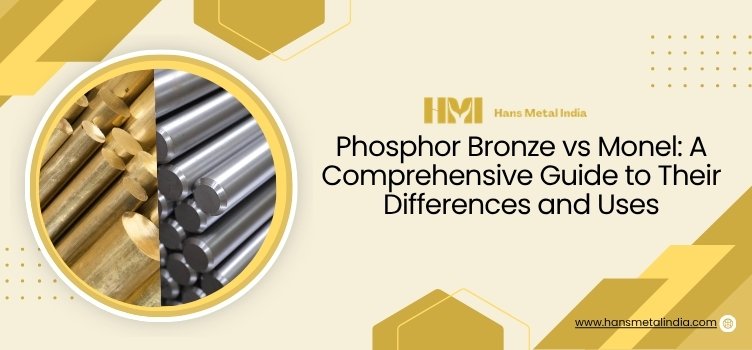
Phosphor Bronze vs Monel is an important material decision for procurement and engineering teams working across marine, chemical, and industrial sectors, as it directly influences cost, durability, maintenance, and service life. These alloys are both recognised as being high-strength and corrosion resistant, but are very different alloys in terms of alloy constituents and extreme applications. Phosphor Bronze vs Monel: A Comprehensive Guide to Their Differences and Uses Phosphor Bronze is a copper-tin alloy with a small amount of phosphorus, designed to have ? superior wear resistance, fatigue resistance, and machinability. It is commonly used as a sliding, and/or impacting, wear-resistant material due to its wear resistance, stability, and affordability.
Monel is an environmentally resistant material. Monel has good resistance to seawater, acids, and alkalis, as well as high-temperature corrosion, which makes it ideal for the marine, equipment, and offshore industries where failure is not an option. This Monel vs Phosphor Bronze comparison shows the differences in strength, corrosion resistance, suitability for use, and cost – and hence the opportunity to select the material based on its performance and the application requirements.
Composition and Material Overview
Phosphor Bronze is a strong alloy of copper that is created by the incorporation of tin and phosphorus. It can be used in the mechanical industry as a result of its balanced structure, which grants strength, wear, and longevity of service.
Monel Alloys is a superperformance nickel-copper alloy that is designed to withstand extreme conditions. Its formulation provides excellent marine and chemical corrosion and durability.
Comparing Mechanical Strength: Monel vs. Phosphor Bronze
Monel is specifically designed for satisfactory performance under varying pressure and temperature conditions, without distortion. It has a stable mass that allows the material to withstand severe operating
conditions, particularly in cases where the material is exposed to corrosive media and mechanical forces for long periods.
Phosphor Bronze offers a more ductile mechanical behavior and is able to withstand extensive flexing and cyclical loads. It exhibits high resistance to wear and abrasion in constant contact applications, with long-term smooth service performance. As a result, it is an ideal material for components that require controlled motion and minimal friction.
On the other hand, Monel is preferred for maximum load-bearing capability under harsh conditions, but Phosphor Bronze is preferred where continuous, reliable operation is required under conditions of motion, vibration, and repeated loading and unloading.
Monel vs Phosphor Bronze Corrosion Resistance
Monel :
- Good for acidic and chemical processing industries
- Resistant to basic chemicals
- Excellent resistance to pitting
- Resistant to stress corrosion cracking
- Dimensional stability in use under severe industrial conditions
Phosphor Bronze:
- Good resistance in normal atmospheric conditions
- Performs reasonably well in seawater
- Performs well in low to moderately corrosive environments
- Provides some protection from surface rusting and oxidation
- Not recommended in strong acids and high-salinity conditions
- Less resistant to corrosive chemicals than Monel
Marine Applications: Monel vs Phosphor Bronze
Monel Applications :
- Seawater pumps, pipeline systems, and valves.
- Industrial offshore heat exchangers.
- Marine shafts and ship propulsion shafts.
- Deep-sea and offshore designs.
Phosphor Bronze Applications :
- Bushings and fittings on ship propellers
- Bearings, sleeves, and bushings
- Electrical connections for marine applications
- Wear parts in moderate marine conditions
Key Usage Difference :
- Monel is chosen for extremely corrosive, rugged marine applications
- Phosphor bronze is chosen for its durability, stability, and affordability in marine applications
Cost Comparison: Monel and Bronze
Monel :
- Expensive to produce and process
- Costly to manufacture and fabricate
- Found in high-quality, high-end products
Phosphor Bronze :
- Helps reduce project expenses
- Available without supply constraints
Key Differences at a Glance
| Property | Phosphor Bronze | Monel |
| Composition | Copper-tin, with a little phosphorus | Made of nickel and copper, with a little iron |
| Mechanical Strength | Achieves a moderate degree of strength in general work applications | Gives a greater strength in challenging conditions |
| Marine Corrosion Resistance | Works fairly well in the typical marine system | Works very well, even in the highly aggressive seawater environments |
| Relative Cost | Less expensive | more applications in critical need |
When to Choose Each Material?
Phosphor bronze should be used for wear resistance, low friction, and economical reasons. It’s best suited for parts operating in continuous or intermittent motion as well as for parts exposed to a mild to moderate marine environment – but not where extreme corrosion resistance is required.
Monel should be used for highly corrosive and marine environments such as seawater, marine structures, and chemical plants. It’s best used for applications where a longer wear life, greater strength, and extremely high corrosion resistance are of importance, rather than the initial cost of the material.
Conclusion
The decision to use Phosphor Bronze or Monel mostly depends on the location and purpose of use. Phosphor bronze is an inexpensive and convenient alternative, providing acceptable wearability and can also tolerate mild corrosion readily, so it can be used in general mechanical components and in marine applications with limited exposure.
Instead, Monel is made of sturdier circumstances. It is more expensive, yet it works very well in very corrosive conditions and in demanding conditions. This is why it is widely applied in critical, marine, and chemical applications, where the most important factor is long-term reliability.
FAQs
1. Which is the material that is more machineable and fabricable?
Phosphor Bronze tends to be less challenging to machine and shape; it is applicable in precision components and mass production parts.
2. Which does it better suit for cost-sensitive projects?
Phosphor Bronze can be used in medium-performance projects that do not require a lot of money.
3. Areas of Monel mostly used in industries?
In marine engineering and chemical plants, offshore platforms, and equipment that are in contact with seawater and corrosive fluids, Monel is also very common.
Can’t decide between Phosphor Bronze and Monel for your application? Contact us or email us at export@hansmetalindia.com to get professional recommendations, product support, and optimal pricing. We can get in touch with you today to get a quick and reliable solution.