
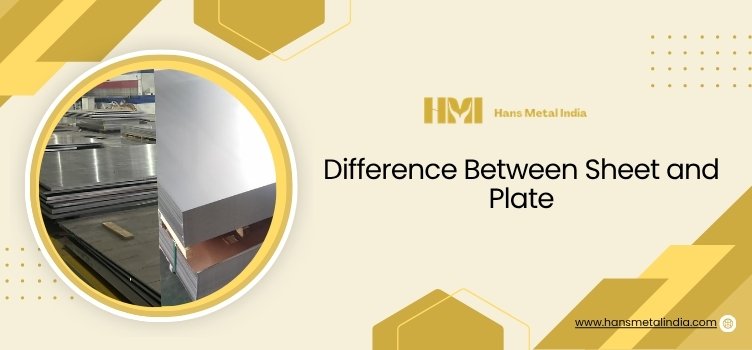
Overview
In the metal manufacturing and fabrication industry, flat metal products are known as Sheet and Plate. Both are similar in appearance but differ in thickness, uses, strength, production, and industrial use. Knowing the difference between Sheet and Plate is necessary for engineers, fabricators, contractors, manufacturers and customers specifying a material for a specific application.
This article will examine the differences between metal sheets and plates, their uses, the advantages of each, and how to select the right one.
Basic Differences
A Metal Sheet is a very thin, flat piece of metal that is made thinner by the rolling method. Metal sheets are light, easy to bend, and create. Sheets are used where it needs bending, cutting, stamping, or forming. Sheets are commonly used in industries where precision and lightweight construction are important.
A Metal Plate is a thicker flat metal product intended for heavy-duty industrial applications. Plates provide greater strength, durability, load-bearing ability, pressure resistance, and impact resistance. Metal Plates are used in a variety of structural, marine, pressure vessel, construction, and industrial equipment manufacturing applications where mechanical strength is essential.
Advantages of Sheet and Plate
| Advantages of Sheet | Advantages of Plate |
|---|---|
| Easy to handle and lightweight. | Strong and durable |
| Very flexible and formable | Suitable for heavy load applications |
| Easy to cut, bend, and fabricate | Better pressure and impact resistance |
| Low cost for light-duty work | Suitable for welding and machining |
| A range of finishes and sizes | Long service life in harsh environments |
Comparison between Sheet and Plate
| Parameter | Metal Sheet | Metal Plate |
|---|---|---|
| Definition | Thin sheet metal parts | Thick sheet metal parts |
| Thickness Range | Usually up to 6 mm in thickness | Usually above 6 mm in thickness |
| Manufacturing Process | Mostly cold rolled | Mostly hot rolled |
| Machining | Limited heavy machining | Machining operations suitable to some extent |
| Weldability | Fair for light work | Excellent for heavy work |
| Durability | Suitable for a moderate environment | Suitable for harsh environments |
How to choose between Sheet and Plate?
You should select based on factors like:
Choose Sheet when:
- A lightweight material is required
- A more complicated formation is used
- Cost efficiency is important
- Precision fabrication is needed
- Aesthetic appearance matters
Choose Plate when:
- The structural strength should be high
- Heavy load applications are involved
- Pressure resistance is a must
- For welding/machining, thick material is required
- High durability for industrial use
Properties of Sheet and Plate
Properties of Metal Sheet:
- Metal sheets are lightweight and easy to transport, and are installed for various purposes
- Metal Sheets are flexible, easily bent, cut, or shaped during production
- Metal sheets normally have a smooth surface finish suitable for major industrial applications
- Metal sheets have high corrosion resistance, such as stainless steel or aluminium
- Metal sheet is used in applications when a clean finish and precise dimensions are needed
Properties of Metal Plate:
- Metal Plates are highly durable and are ideal for heavy-duty industrial applications
- Metal Plates are built to have high thickness for high load-bearing capacity as well as structural stability
- Metal Plates will not bend under pressure, impact, or rugged working conditions
- Metal Plates are highly weldable and machinable for large-scale fabrication
- Metal Plates are extremely sturdy and wear-resistant; they are perfect for long-term industrial usage
Conclusion
Metal Sheet and Plate play an important role in modern manufacturing and industrial uses. Sheets are used in lightweight, flexible, and precision applications, while plates are used in heavy-duty, strength, and durability applications.
Identifying the difference between Sheet and Plate enables industries to choose the appropriate material for their fabrication and construction, engineering, and manufacturing projects. Along with attributes like thickness, strength, application needs, and price, companies can optimize their performance, efficiency, and long-term reliability.
FAQs
1. What makes a Sheet and a Plate different from each other?
Sheets and Plates mostly have the same material but differ in thickness. Metal Sheet is thin and flexible, whereas Metal Plate is thick and strong and is applied for heavy-duty uses.
2. Which is stronger? Sheet or Plate?
The thickness and load-bearing capacity of Metal Plates make them stronger than the Sheets.
3. What is the common use of metal sheets?
Roofs, automotive panels, kitchen equipment, HVAC systems, furniture, and decorative applications are some of the typical applications for Metal Sheets.
4. Are Metal Plates used for welding?
Yes, Metal Plates have excellent weldability for large fabrication and structural projects.
Are you looking for the best quality Sheet and Plate? Contact us or email us at export@hansmetalindia.com today to get the right choice of Sheet and Plate.