
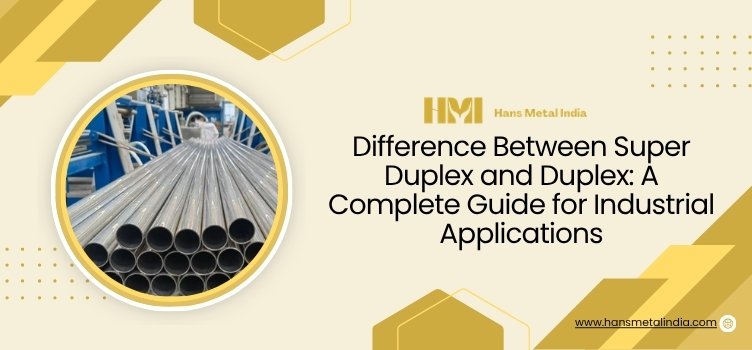
Difference Between Super Duplex and Duplex: A Complete Guide for Industrial Applications
Understanding the Key Differences That Impact Performance and Cost
The Duplex and super duplex stainless steel are common in challenging industrial applications, particularly where strength and corrosion resistance are a priority. Although it is evident that both materials have a more or less dual-phase microstructure comprised of austenite and ferrite, the performance features of the two materials are vastly different. It is vital to know the Difference Between Super Duplex and Duplex to make the correct choice of material to use in your project.
In other industries, like automotive, oil and gas, and chemical processing, failure of materials may result in expensive downtime and hazards. This paper compares super duplex vs duplex by discussing the characteristics of those types, their usage, and prices. In the end, you will be in a position to have a clear idea of the material that best fits your operational needs.
Duplex Stainless Steel Properties and Applications
Duplex stainless steel has been characterized by having a balanced microstructure, which is a combination of strength and corrosion resistance.
Key Properties:
- Moderate to high strength (Stronger than austenitic stainless steels).
- Excellent stress corrosion cracking resistance.
- Economical, because of reduced alloying elements.
Common Applications:
- Motor automotive structures.
- Heat exchangers.
- Pressure vessels.
- Water treatment systems.
Duplex stainless steel properties ensure that it is applicable in situations where moderate corrosion resistance and low cost are needed.
Super Duplex Stainless Steel Properties and Applications
Super duplex stainless steel is a new grade with increased alloy content, even more so chromium, molybdenum and nitrogen.
Key Properties:
- Very high strength of up to 2x standard duplex.
- Better resistance to corrosion, particularly in chloride conditions.
- Excellent pitting and crevice resistance to corrosion.
- Increased resistance to adverse conditions.
Common Applications:
- Offshore and marine products.
- Chemical processing equipment.
- Desalination plants.
- Automotive high-performance parts.
These are super duplex stainless steel properties that ensure that it is perfect in aggressive environments where failure is not an option.
Super Duplex vs Duplex Corrosion Resistance
One of the most important concerns in the choice of materials is corrosion resistance.
- Duplex stainless steel has a moderate ability to resist both general corrosion and stress corrosion cracking.
- Compared to other stainless steels, super duplex stainless steel is much more resistant to pitting corrosion and crevice corrosion, particularly in a chloride-rich environment.
Conclusion: Super duplex is preferable in extremely adverse conditions, such as marine and chemical exposures.
Super Duplex vs Duplex Magnetic Properties
The two materials can be said to have magnetic characteristics as a result of their ferritic constituent.
- Duplex steel stainless: Partially magnetic.
- Super duplex stainless steel: More magnetic than duplex stainless steel.
But in most of the industrial applications, the distinction between super duplex vs duplex magnetic properties is not a determining factor.
Super Duplex vs Duplex Weldability and Machinability
Weldability:
- Duplex stainless steel: It is more easily welded using standard procedures.
- Super duplex stainless steel: Has to be heat-controlled, and welding must be a skill.
Machinability:
- Duplex stainless steel: It is more easily machined than super duplex stainless steel.
- Super duplex stainless steel: More difficult to machine than duplex stainless steel.
Conclusion: Super duplex is preferable in applications where weldability and machinability are a concern.
Super Duplex vs Duplex Cost
The element of cost is important in the selection of materials.
- Duplex stainless steel: Less expensive as a result of reduced alloy content.
- Super duplex stainless steel: It is more expensive but has a longer service life.
Conclusion: Super duplex is preferable in applications where cost is a concern.
Super Duplex vs Duplex Applications
- Duplex stainless steel: Used in applications where moderate corrosion resistance and low cost are needed.
- Super duplex stainless steel: Used in applications where high corrosion resistance and high strength are needed.
Although super duplex and duplex costs might appear to be a negative factor, the lifecycle cost might be more in favour of super duplex in corrosive environments because of lower maintenance and replacement.
Comparison Table: Super Duplex vs Duplex Stainless Steel
| Property | Duplex Stainless Steel | Super Duplex Stainless Steel |
|---|---|---|
| Strength | High | Very High |
| Corrosion Resistance | Good | Excellent |
| Pitting Resistance (PREN) | ~25–35 | >40 |
| Weldability | Good | Moderate (requires expertise) |
| Machinability | Moderate | Difficult |
| Cost | Lower | Higher |
| Typical Applications | General industrial use | Extreme environments |
Conclusion
The Difference Between Super Duplex and Duplex is mostly in their alloy structure, strength and corrosion resistance. Duplex and super duplex stainless steel are efficient and inexpensive when it comes to general use and extreme applications, respectively.
Super duplex vs duplex: the decision would be based on your particular needs, be it cost effectiveness, the ability to fabricate it easily or its resistance to corrosion over a period of time. In high-risk applications, as well as in high-performance applications, super duplex can be economical in the long run.
FAQs
1. What is the main difference between super duplex and duplex stainless steel?
Alloy composition and performance are the differences. Super duplex contains increased chromium, molybdenum and nitrogen, which leads to enhanced strength and corrosion.
2. Which is better: super duplex or duplex stainless steel?
It will be determined by the application. Duplex can be used for general purposes, whereas super duplex can be used in corrosive environments such as marine life and chemical sectors.
3. Is a super duplex more expensive than a duplex?
Yes, the upfront cost of super duplex stainless steel is higher, but that is usually compensated by the greater long-term benefits of the material, which is cheaper to maintain than others.
Looking for high-quality super duplex stainless steel or duplex stainless steel for your industrial or automotive applications? Get in touch with our experts today for tailored solutions and competitive pricing. Contact us today or email us at export@hansmetalindia.com request a custom quote now!